
What's the Difference Between Metered Billing and Rateable Value Billing?
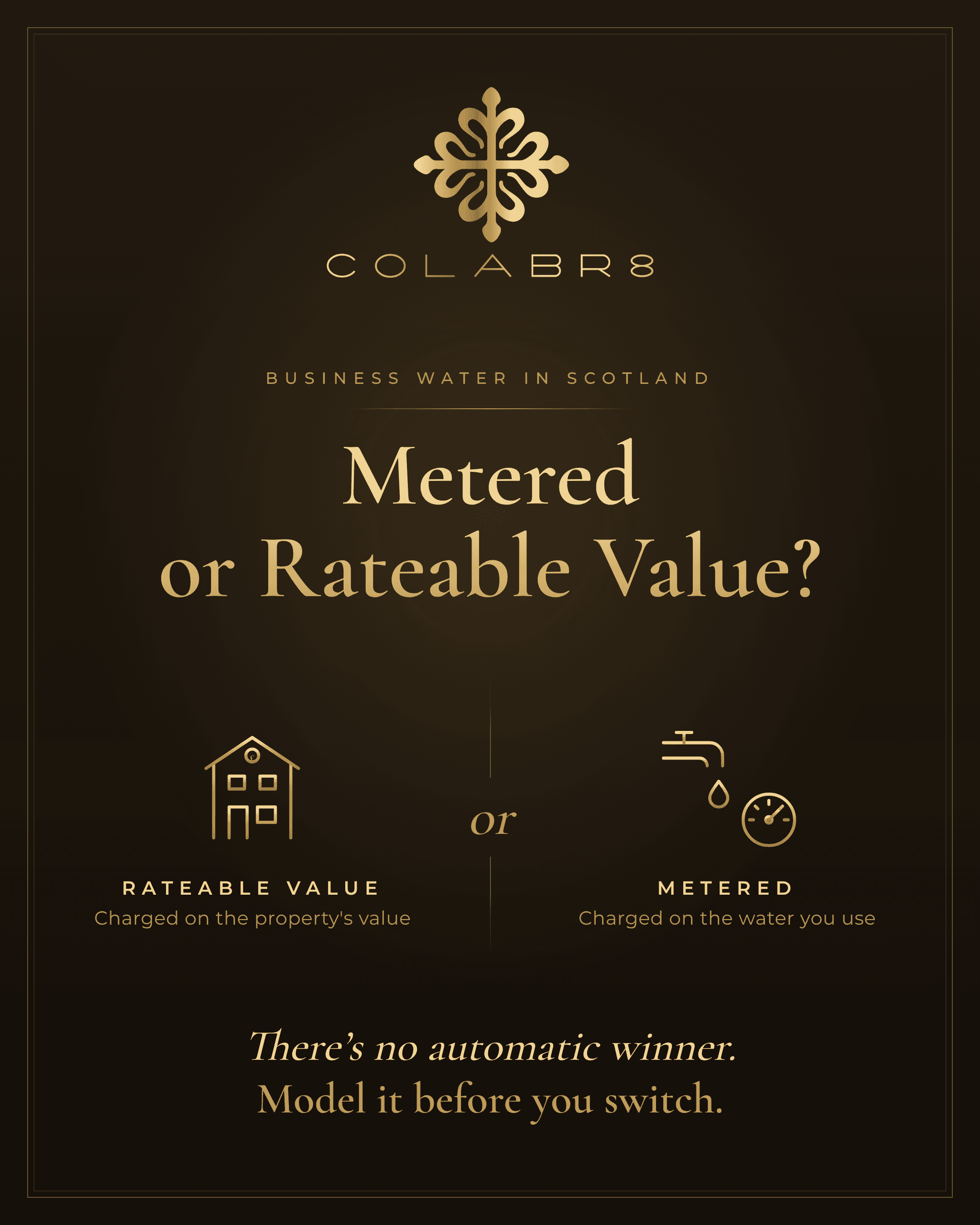
If you run a business in Glasgow, Edinburgh, Paisley or anywhere else in Scotland, your business water and waste water charges are usually worked out in one of two ways: Rateable Value (RV) billing or metered billing.
The simplest way I explain it:
RV billing means you pay mainly according to the value of your property. Metered billing means you pay mainly according to how much water you actually use.
Simple enough. The catch is that neither option is automatically cheaper.
We've seen a Glasgow launderette move to metered charging and watch its bills nearly double. It had a fairly low RV but used a lot of water.
At the other end of the scale, a Glasgow optician in premises with a £98,000 RV used very little water. Moving to metered charging almost halved its bill.
Same decision, completely different result. That's why my advice is always the same: model it before anyone switches.
How business water billing works in Scotland
Scotland's non-household water market opened to competition on 1 April 2008. Since then, businesses have bought their retail water services from licensed providers, regulated by the Water Industry Commission for Scotland (WICS).
Scottish Water still owns and runs the wholesale network: the pipes, treatment works and sewers. Your bill comes from your licensed provider.
Whichever provider you use, your property's water and waste water will normally be charged on one of two bases: Rateable Value or metered. Think of them as two ways of answering the same question: how much should this property pay?
Rateable Value billing
Metered billing
What drives the charge
The property's RV
The water you use, plus a fixed meter charge
Does usage matter?
No
Yes
Predictable?
Very
Varies with usage
Leaks
Don't change the bill
You pay for the lost water
Drainage charges
Based on RV
Usually still based on RV
Usually suits
Low-RV, high-use premises
High-RV, low-use premises
What is Rateable Value billing?
RV billing is sometimes called unmeasured billing. Instead of measuring what comes out of your taps, the charges are worked out from your property's Rateable Value. In simple terms, the higher the RV, the higher the RV-based water charges.
The key point is that how much water you use doesn't decide the charge. Two businesses in properties with the same RV could use very different amounts of water and still pay the same.
Picture a quiet office with two people, and a busy business using water all day. Under RV billing, that difference in usage doesn't necessarily matter.
Why RV billing can be the better option
The first advantage is predictability. Your bill doesn't go up because someone used more water that month.
More importantly, businesses with a low RV but high water use can be much better off staying on RV billing.
The Glasgow launderette is a good example. Its RV was fairly low, but it used a lot of water, as you'd expect. A meter might sound like the obvious modern option. Once real usage was taken into account, its bills nearly doubled.
That's why "get a water meter" is not automatically good advice.
What is metered water billing?
Metered billing works much more like people expect. A meter records how much water comes into the property. The business then normally pays:
- a fixed charge linked to the size of the meter, plus
- a volume charge for the water used.
Waste water is usually charged on the same measured volume, less an allowance for water that doesn't go back to the sewer.
The principle is simple: use less, pay less; use more, pay more. That makes metering very attractive for businesses in high-RV properties that use very little water.
A Glasgow optician almost halved its bill
The optician is the flip side of the launderette. Its premises had an RV of £98,000, but the business used very little water.
That's exactly the kind of mismatch we look for. The property's value was driving the water charges, even though the business hardly used any water. Moving to metered charging almost halved the bill.
The lesson isn't that meters save money. It's that the balance between your RV and your real usage decides whether a meter makes sense.
A free water meter isn't a risk-free decision
This is probably the most important part of the article.
Scottish Water fits the meter free of charge, so it's natural to think: "Why not just try it?"
Because it isn't a trial. Moving away from RV charging is a permanent change to how the property is charged. Once you've applied, you can't go back to your RV charge if the numbers don't work out. There's no trial period, and metered charges aren't backdated either.
That's why at COLABR8 we never apply for a meter first and do the maths afterwards. We do the maths first.
That means working out realistic yearly usage and comparing it with your current RV-based charges. And realistic matters. Don't take a quiet month and multiply it by 12 if the business is seasonal. Think about:
- staff numbers and opening hours
- toilets, kitchens and showers
- cleaning and catering
- manufacturing or process water
- irrigation
- seasonal peaks
- planned recruitment or expansion
- possible leaks
The saving should be big enough to absorb normal ups and downs in usage. If the numbers are close, I'd be very cautious about making a permanent change.
The meter measures the taps, not the rain
Another common misunderstanding is that a meter makes your whole water bill usage-based. It doesn't.
The meter measures what comes through your taps. It can't measure the rain falling on your roof.
A business water bill can include four parts:
- Water coming in
- Waste water going out to the sewer
- Property drainage: rainwater from your roof, yard and car park going into the public sewer
- Roads drainage: your share of draining the public roads
Drainage charges are normally based on the property's RV, even when the water and waste water are metered.
So a large warehouse with a handful of staff might have a tiny metered water charge, but still a sizeable drainage charge. That's why any meter comparison should only compare the charges that will actually change. Otherwise you're comparing the wrong numbers.
Your RV still matters if you have a meter
This is why we check the RV even when a client already has a meter. If drainage is still based on RV, a wrong RV means you're still overpaying.
Check the RV on your water bill against the Scottish Assessors' valuation roll. Then ask whether that entry describes the property you actually occupy today.
Properties change. Units get split, businesses give up floors, neighbouring units are merged, and uses change. If the records haven't kept up, your water bill may be wrong too.
Small Business Bonus doesn't reduce your water bill
This catches out plenty of business owners, and it's an understandable mistake. You might get Small Business Bonus Scheme relief and pay little or nothing in business rates. That doesn't mean your water bill should shrink too. Water and sewerage charges are completely separate from business rates.
Your rates relief reduces your rates bill. It doesn't reduce your property's Rateable Value, and your water charges can still be based on that RV.
If the RV itself goes down after a revaluation or a successful appeal, that can reduce the RV-based water charges too.
Charities and community amateur sports clubs may qualify for a separate Water and Sewerage Charges Exemption Scheme. It depends on your income, you apply through your provider, and you have to reapply every year. It's worth checking, rather than assuming your rates relief carries across.
Before you compare: is your bill actually right?
This is where our approach differs from simply asking: "Would a meter save me money?"
That's not the first question I'd ask. The first question is: is the bill you're paying now correct?
Check the SPIDs
Every supply has a Supply Point ID (SPID). Check that the water and waste water SPIDs on your bill really belong to your premises.
This matters most where buildings have been split, joined or changed over time. An old supply reference from a neighbouring or former unit causes problems that switching provider won't fix.
Check what you're being charged for
- Waste water: are you actually connected to the public sewer? Some rural and industrial properties use septic tanks or private systems.
- Surface water: does rainwater actually go into the public sewer? Or does some or all of it go to a soakaway, watercourse or private drainage system?
Don't assume a line on the bill is right just because it's been there for years.
Check the lease
This matters most in shared buildings and business centres. Does your landlord already recover water or sewerage costs through the service charge? If you also get your own water bill, find out exactly what each one covers. You don't want to discover you've been paying twice.
Check your billing history
We normally want at least 12 to 24 months of bills, and longer if there's a possible historic issue. Look for:
- estimated meter readings
- sudden jumps in usage
- catch-up bills
- duplicate charges
- wrong tariffs
- periods when the property was empty
- changes to the RV
- missing or unexplained billing periods
A small error repeated year after year can be worth far more than shaving a few percent off your contract.
If you're metered, check the meter too
Being on a meter doesn't guarantee the billing is right.
- Actual or estimated readings? Months of estimates can hide a problem and end in a nasty catch-up bill.
- Meter size: an oversized meter carries a higher fixed charge, which can eat into the saving you expected.
- Leaks: on RV billing, a leak doesn't change the charge. On a meter, you pay for every litre lost.
A simple check: take a reading when you close, make sure nothing should be using water overnight, and read it again before you open. If the meter has moved, investigate.
Don't forget water that doesn't go down the drain
Not every litre that comes in goes back to the sewer. Some ends up in products, some evaporates, and some is used for irrigation or processes. Where a large share doesn't return to the sewer, you may be able to claim a non-return allowance. For water-heavy businesses, that can make a real difference to the waste water charge.
How we decide whether a meter makes sense
Once we're happy the account is right, we can make a fair comparison:
- Work out realistic yearly water use.
- Calculate what the property would pay on a meter.
- Compare that with the RV-based water and waste water charges. Leave drainage out, because it doesn't change.
- Find the break-even point: the yearly usage at which both options cost the same.